
Ask rediffGURU Naveenn Kummar your insurance mutual fund and personal finance-related questions.
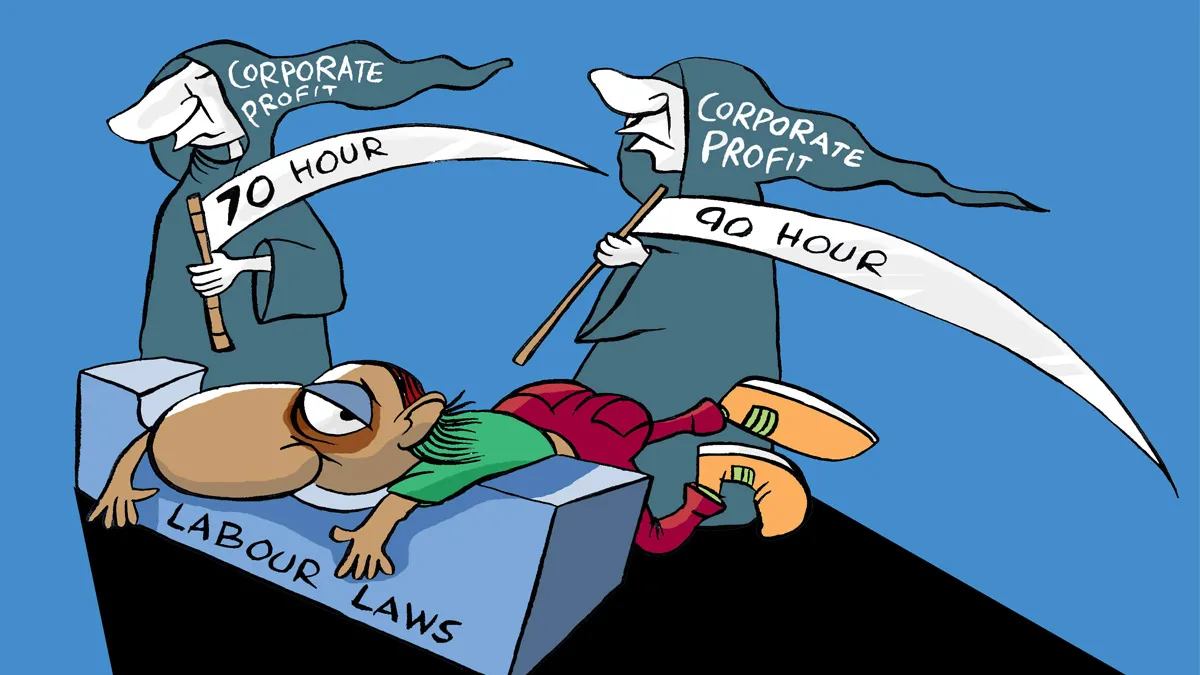
The Indian government has notified final rules under four labour codes, potentially enabling a four-day workweek in certain sectors by capping weekly working hours at 48 while allowing daily flexibility. This move also introduces significant changes to wage fixation, compliance obligations, and social security norms.

Yet another first week of December brought familiar scenes of rain, storm, flooding, power outages, and fallen trees. When Cyclone Michaung wreaked havoc, leading to the heaviest rainfall in 47 years in the city, residents of Chennai drew parallels to the devastating floods of 2015. However, initial data on insurance claims suggests that the impact this time may portray a more optimistic scenario.

India's privatisation push, once projected as a cornerstone of economic reform, has suffered another setback, with the Centre set to call off the IDBI Bank stake sale, highlighting the political and structural constraints shaping the country's disinvestment policy, experts say.

'$125 million for the hull and the remaining of over $350 million for liability.'

A nationwide strike called by central trade unions saw a mixed response across India, impacting various sectors and states differently, with some areas experiencing disruptions while others remained largely unaffected.

Recent changes to tax exemptions and allowances, including increased education, hostel, and HRA limits, have made the old tax regime more competitive against the new regime, prompting salaried employees to re-evaluate their choice for the current financial year.

'It has always been viewed as a hedge against inflation.'

The insurance regulator's move to prod insurance companies to sell health products to all age groups, including those above 65, is aimed at increasing penetration though there would be challenges on pricing due to higher risk perception, experts said. While there was no regulatory cap on age for health insurance policies, most companies had an internal policy which did not allow them to sell health insurance products to persons over 65.
The Indian insurance industry is set to focus on customer-centric technological adoption and expansion into rural areas to drive growth in 2025.

Ask rediffGURU and PF expert Milind Vadjikar your insurance, stocks, mutual fund and personal finance-related questions.
Health insurance premium growth has slowed after touching record highs during the Covid-19 pandemic due to tapering demand from retail consumers amid affordability issues. According to General Insurance Council data, health insurance premiums grew by 10.44 per cent year-on-year (Y-o-Y) in the Apr-Jan period of FY25 in comparison with 20.79 per cent in the year-ago period. It was around 23.57 per cent in FY23, and 25.89 per cent in FY22.

Only 2.5 per cent of the equity in Jio Platforms will be offloaded through the OFS route -- meant for secondary share sale.

Tenants should primarily buy contents insurance. 'This covers personal belongings like electronics, furniture, clothes, and appliances against risks such as fire, theft, floods, and other natural calamities.

'In investing, poor sentiment is always a good vintage to build a portfolio.'

The Insurance Regulatory and Development Authority of India's (Irdai's) decision to allow insurers to hedge risks through equity derivatives will help them manage market volatility and protect policyholder returns. However, this move is unlikely to alter their investment strategies.

The regulatory changes brought in by the insurance regulator and the amendments proposed to the Insurance Act by the Centre may herald a new dawn for the sector in India. This may result in insurers bringing out more consumer-led products, top honchos of general insurance companies of the country concurred at the Business Standard BFSI Insight Summit 2022.

Most first-time investors may be better served by diversified options such as flexicap or multi-cap funds, which already hold pharma and healthcare stocks.

Multiple reasons accounted for the losses, including manpower crunch and lack of clarity on the merger of National, United and Oriental, reports Namrata Acharya.

'Being an important institution in the banking system, we are subject to regulatory supervision, both offsite and onsite.' 'When you look at the intensity at which these levels of supervision come, we, on the board and in management, believe there should not be any surprises.'

If the oil infrastructure is attacked by the United States, the whole area could be flooded with oil, spilling into the Persian Gulf.

The NITI Aayog has recommended privatisation of state-owned insurer United India Insurance Company as the government aims to move ahead with its new public sector enterprise (PSE) policy for Atmanirbhar Bharat. The policy think tank has suggested that the public sector insurer be considered for privatisation in the banking, insurance and financial services sector, which has been classified as 'strategic' in the PSE policy, said an official. The policy proposes the "bare minimum" presence of government-owned companies in strategic sectors, and privatisation, merger or closure of remaining public sector undertakings (PSUs).

'Every day the meter is ticking. Like a time bomb.' Shipping giants are billing Indian exporters up to $3,000 per container in war surcharges -- on cargo that sailed before the war began -- as the Strait of Hormuz shuts down.

Some of the key names include: Maruti, M&M, Ashok Leyland, Britannia, Ultratech, JK Cement, Havells, Voltas, Amber, Metro, Trent, LemonTree, Indian Hotels, Niva Bupa, HDFC Life, IGL, Acme Solar, Suzlon, Swiggy, Delhivery, ICICI Bank, HDFC Bank, Bajaj Finance, Shriram Finance," according to a report by Motilal Oswal Financial Services.

ICICI Prudential Asset Management Company has set a price band of Rs 2,061- Rs 2,165 per share for its Rs 10,600-crore initial public offering (IPO) that will open on Friday. At the upper end of the band, the country's largest asset manager will command a valuation of Rs 1.07 trillion.

Bajaj Finserv - the holding company of Bajaj group's financial services business - has laid out plans for the next five years. During this period, it is eyeing 18-22 per cent compound annual growth rate (CAGR) in net profit at Rs 21,000-24,000 crore on a consolidated basis.

The Union Cabinet has approved amendments to the General Insurance Business (Nationalisation) Act, paving the way for privatisation of government-owned insurers. The amendments, approved by Cabinet, will remove the clause for the Centre to hold at least 51 per cent in public sector insurance companies at any given time. It will also have an enabling provision for the transfer of management control from the government to the potential buyer of the public sector insurance company. The finance ministry will move amendments to the insurance Act in the ongoing Parliament session.

Over the past three years, the appointments of 20 candidates selected through the Institute of Banking Personnel Selection were cancelled or offers were withdrawn due to poor credit history.

In Debasish Panda's last board meeting as chairperson of the Insurance Regulatory and Development Authority of India (Irdai), the regulator approved the "R2" licence for Kamlesh Goyal and Prem Watsa-backed Value Attics Reinsurance, making it the first private-sector Indian reinsurer after GIC Re, the public-sector reinsurer. "The authority reviewed and approved the R2 application of Value Attics Reinsurance, making it the first private-sector reinsurer after GIC Re, the public-sector reinsurer.

The market capitalisation of BSE-listed companies eroded by Rs 9,40,581.75 crore to Rs 4,50,61,658.60 crore (USD 4.90 trillion) in a single day.

West Asia conflict triggers sharp sell-off in Indian markets, with realty, banking and auto stocks leading losses amid energy shock fears.

Munich-based Allianz will explore new opportunities in the Indian insurance market not only as an investor but also as an operator, the company told Business Standard on Tuesday. "India will continue to be one of Allianz's main growth markets, and Allianz will explore new opportunities to further grow its participation in the Indian insurance market in the future, not only as an investor but also as an operator," the company said.

The finance ministry is in favour of extending the August deadline for public sector banks (PSBs) as well as insurance companies to increase their minimum public shareholding (MPS) to the mandated 25 per cent, said a senior government official. "The election results will determine the course of action. "Most likely, those who did not receive an extension to meet the minimum shareholding norm will be granted one," the senior government official said.

Bhargav Dasgupta, managing director and chief executive officer of ICICI Lombard, tells Subrata Panda, in an interview that the company has adequate capital for now and does not see a need for fresh infusion through markets over the next few years.

'The slowdown in motor insurance premium growth is due to slower growth in vehicle sales. Also, there has been minimal hike in third-party rates in the past three years which is affecting the growth rate of third-party premiums.'

'As on August 25, 94,753 Govindas have been insured.' 'This number is expected to rise further, as proposals for 5,000 to 8,000 Govindas are received daily.'

HDFC Bank is engaging external legal firms, both domestic and international, to investigate the circumstances surrounding former part-time chairman Atanu Chakraborty's resignation.

'If you want it to grow well and serve the true needs of the economy, it needs a lot of freedom and flexibility, which comes in terms of the reform objective set by the regulator.'

'India has not faced a major terrorism loss since the Mumbai terrorist attacks in 2008.'

The Insurance Regulatory and Development Authority of India (IRDAI) is considering a proposal to make insurance frauds a parameter for calculating credit scores in an attempt to put a lid on the increase in such activity. The proposal, which is a part of the recommendations made by a working group formed by Irdai and the General Insurance Council, suggests that insurance frauds should feature when the risk profiles of individuals are evaluated and should be used to calculate their credit scores. A poor credit score can deprive a person of financial services such as loans and credit cards, and deter him from indulging in fraud.
